Calculating the right position size for CFD’s doesn’t need to be complicated. Unlike traditional stock investing, especially in markets like the US, CFD trading involves different mechanics, leverage, and costs. Let’s explore CFD trading position size calculations.
What are CFDs, Really?
A Contract for Difference allows you to speculate on the price movements of an asset such as a stock without owning the actual shares. Unlike traditional investing, you never physically buy or sell the underlying asset. Instead, you enter an agreement with your broker to exchange the difference in the price of the asset from when you open the position to when you close it.
For example, if you believe a stock currently priced at £50 will increase, you could buy CFDs instead of shares. If the price rises to £55, you profit by £5 per CFD contract. If the price falls to £45, you lose £5 per contract. Your profit or loss depends purely on price movement, not ownership.
How to Calculate Position Sizes for CFDs
Calculating position size for a CFD trade involves clearly defining your risk level and understanding how each contract relates to the underlying asset.
Let’s consider a straightforward example. Suppose you want to trade a stock priced at £10 per share, and you decide you want to risk only £100 on the trade:
- First, determine your entry price (£10) and your stop-loss price (the price at which you’ll exit the trade if it moves against you, say £9).
- Calculate your potential loss per contract. If your stop-loss is £9, your potential loss per contract is £1 (£10 entry – £9 stop-loss).
- Divide your total risk (£100) by your potential loss per contract (£1). This means you can trade 100 CFD contracts (£100 risk ÷ £1 per contract risk).
- Your total exposure (position size) in this trade is then 100 contracts × £10 per contract = £1,000.
Differences Between CFD Position Sizing and US-style Trading
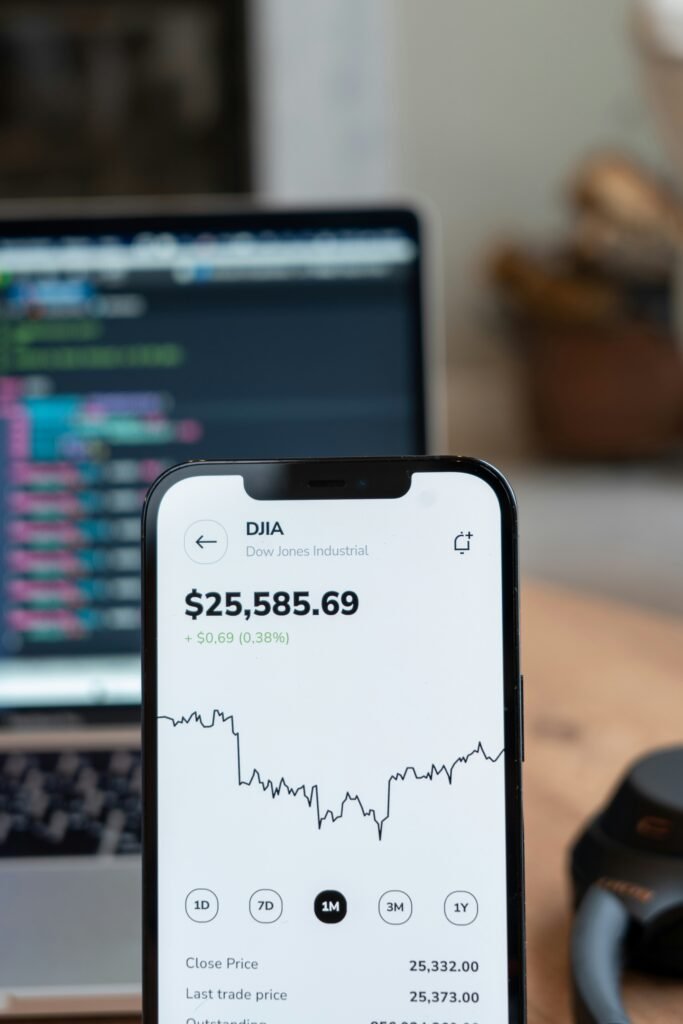
In traditional US stock trading, you buy actual shares. If a stock is priced at $10 per share and you want to invest $1,000, you simply buy 100 shares outright. Your risk is the entire $1,000 investment because you own the shares outright.
CFD trading is different because you trade on margin, meaning you only deposit a fraction of the trade’s full value. If the margin requirement is 10%, you only deposit £100 to open a £1,000 position. Although this allows you to control larger positions with less upfront capital, your losses can exceed your initial deposit if the market moves against you significantly.
Costs Associated with CFDs
Trading CFDs involves specific costs that you need to be aware of to manage your trading effectively.
The main cost is the “spread,” the difference between your broker’s buying price and selling price. For example, if a stock’s market price is £50, your broker may offer a buying price of £50.20 and a selling price of £49.80. If you buy one CFD, you pay the higher price (£50.20), creating an immediate cost of £0.20 per contract.
There may also be commissions charged per trade, particularly when trading CFDs on shares. Additionally, if you hold CFD positions overnight, you incur “overnight financing” charges based on the total value of your position and prevailing interest rates.
For example, holding a £10,000 position overnight with an interest rate of 3% annually would incur a daily financing charge (approximately £0.82 per day).
Investing vs CFD Trading Clearly Compared
Investing traditionally means buying actual shares or assets, typically held for long periods. Investors benefit from price appreciation and dividends, making investing relatively straightforward with defined risks.
CFD trading, by contrast, is speculative and generally short-term, involving leverage, margins, and no actual ownership of the underlying assets. It’s suitable for traders who want exposure to asset price movements without needing substantial capital to own the assets outright.
Personal Experience Trading CFDs
When I first started trading CFDs back in 2012, I underestimated the importance of position sizing and clearly understanding costs. I learned through experience that calculating exact position sizes helps manage risk significantly. Defining clear entry and exit points and consistently applying risk management principles became critical to my trading success.
From experience, I suggest starting with small positions and gradually increasing your trade sizes as you gain confidence. Use tools like a position size calculator to help determine precise and manageable position sizes based on your account size and risk appetite.
How to Start with Position Size Calculation
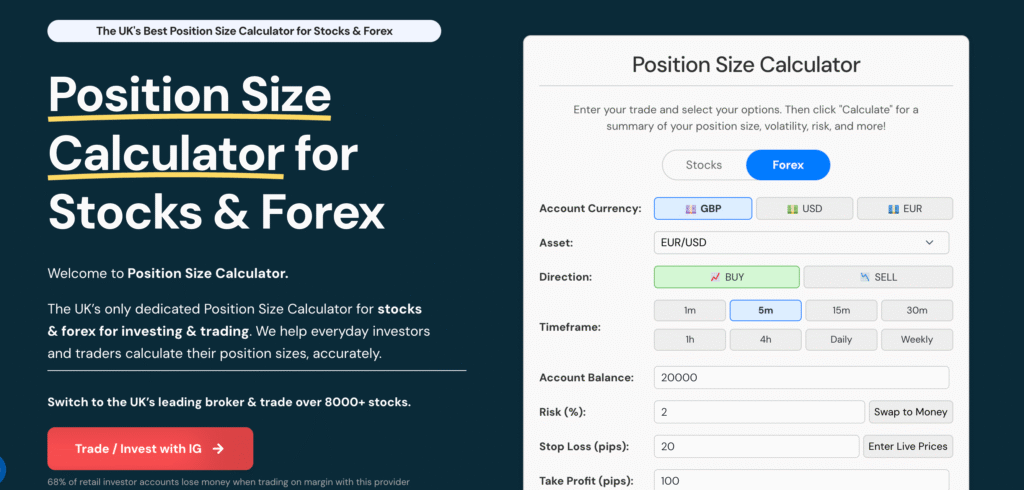
Using a position size calculator is an efficient way to manage your CFD trades accurately:
- Define the entry and stop-loss levels for your trade.
- Specify the exact amount you’re willing to risk on the trade (either as a percentage of your account or as a fixed amount).
- Enter these values into a reliable position size calculator to instantly see how many CFD contracts you can trade without exceeding your defined risk.
This structured approach will help ensure you are consistently trading within your risk limits, significantly improving your chances of long-term success.
Conclusion
Correct CFD position sizing is essential for successful trading. CFDs differ from traditional investing & Spread Betting, due to leverage, margin, and unique cost structures.
By clearly defining your risk, accurately calculating position sizes, and consistently using position size calculation tools, you can trade CFDs confidently and responsibly.
Personal experience taught me the value of precise calculations and risk management. Following these guidelines will help you trade smarter and protect your capital effectively.

John is a leading investor and experienced trader with over 15+ years investment advising & trading for large firms like HSBC & Barclays. He lends his investment eye over our more financially focused articles and ensures compliance & regulatory standards.